
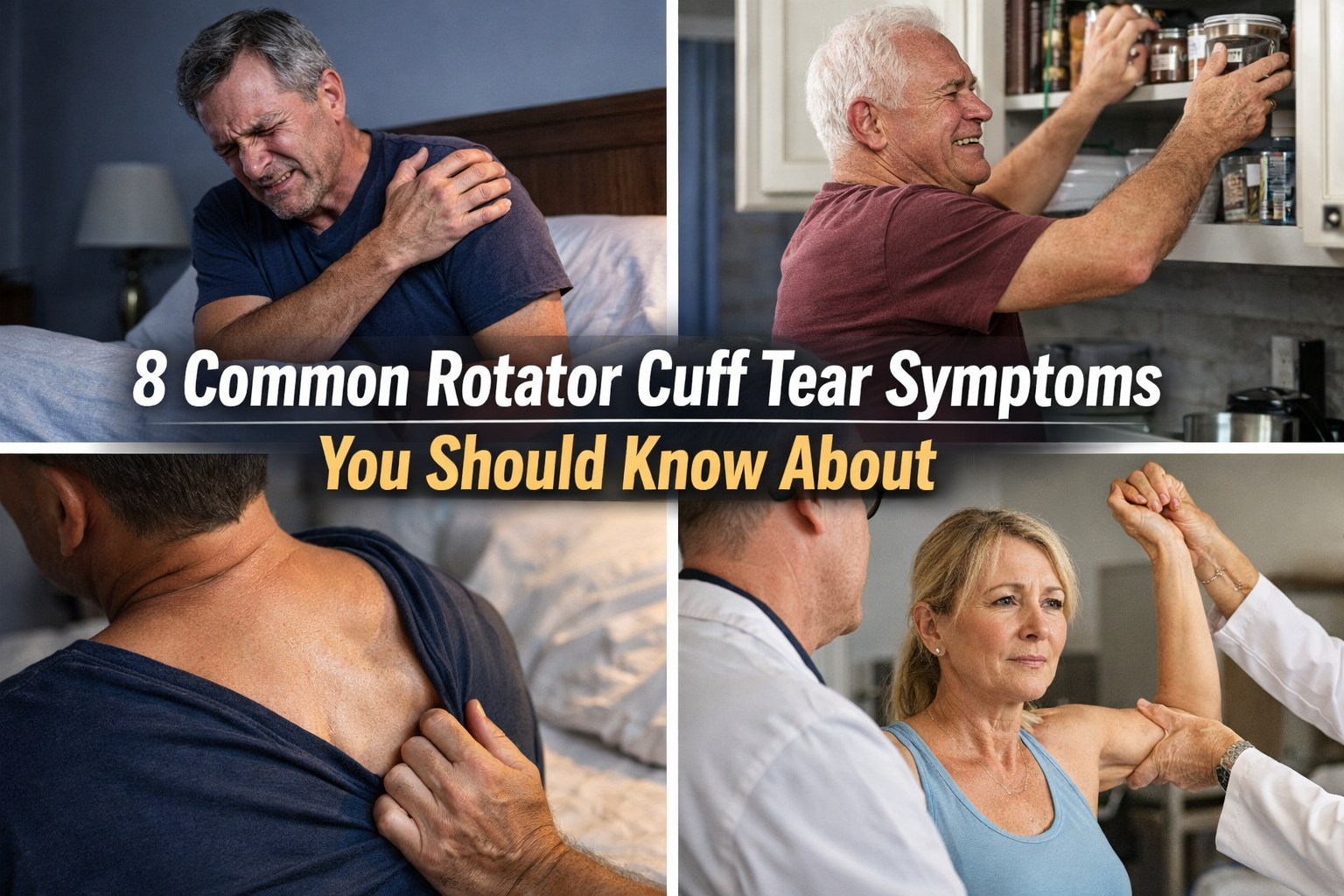
8 Common Rotator Cuff Tear Symptoms You Should Not Ignore
8 Common Rotator Cuff Tear Symptoms You Should Not Ignore
Shoulder pain is easy to brush off at first. Many people assume they slept wrong, strained a muscle at the gym, lifted something awkwardly, or simply “overdid it” during a busy week. But when pain keeps returning, overhead movement becomes harder, or the arm starts feeling weak, a rotator cuff tear moves higher on the list of possibilities. Rotator cuff injuries are common, especially with age and in people who do repeated overhead work or sports, and they can range from irritation and inflammation to partial or full tendon tears.
The rotator cuff is the group of muscles and tendons that helps keep the top of the upper arm bone centered in the shoulder socket while allowing you to lift and rotate the arm. When one of these tendons tears, the shoulder can become painful, weak, less stable, and harder to use in ordinary life. Getting dressed, washing your hair, reaching into a cabinet, carrying groceries, or sleeping comfortably on one side can suddenly feel much more difficult than they should.
It is also important to keep one point clear: rotator cuff tears do not always cause dramatic, unmistakable symptoms. Some people have a tear with only mild discomfort, and some rotator cuff injuries may not cause pain at all. That is one reason these injuries are sometimes missed or mistaken for bursitis, impingement, arthritis, or “general shoulder strain.”
1. Persistent shoulder pain that does not fully settle
One of the most common warning signs is ongoing pain in the shoulder, especially along the front or outer side. People often describe it as a dull ache rather than a sharp stab, at least in the beginning. The pain may flare when lifting the arm, lowering it, or using the shoulder in certain positions, and it may radiate down the upper arm toward the elbow.
This kind of pain often does not behave like simple post-workout soreness. Instead of improving steadily with a little rest, it keeps returning, lingers for weeks, or gets worse with repeated use. If shoulder and arm pain has become chronic or is clearly trending upward, that is a strong reason to have it evaluated rather than continuing to “work through it.”
2. Weakness when lifting, rotating, or holding the arm up
Pain is common, but weakness is often what makes people realize something more serious may be happening. A torn rotator cuff can weaken the shoulder enough that lifting objects, reaching away from the body, rotating the arm, or holding the arm overhead becomes noticeably harder. Daily tasks such as carrying a bag, pouring from a heavy container, putting away dishes, or even fastening clothing can start to feel unreliable.
This weakness may come on gradually with degenerative tears, or it may appear suddenly after a fall, forceful pull, or another acute injury. Immediate weakness after an injury deserves prompt medical attention, because Mayo Clinic specifically notes that sudden arm weakness following an injury should be assessed right away.
3. Reduced range of motion and a shoulder that feels “stuck”
Many rotator cuff tears make the shoulder harder to move through a normal range. People may notice they cannot comfortably reach overhead, behind the back, or out to the side the way they used to. Sometimes the main problem is pain-limited movement. In other cases, the shoulder also develops stiffness and a real loss of motion.
This can show up in ordinary moments before it shows up in sports or workouts. You might struggle to put on a shirt or coat, tuck in the back of your shirt, reach for the seat belt, or wash the back of your hair. When shoulder motion keeps shrinking instead of recovering, it is worth taking seriously.
4. Night pain that interrupts sleep
Night pain is one of the classic complaints in rotator cuff problems. AAOS and Mayo Clinic both note that rotator cuff tears often hurt at rest and at night, especially when lying on the affected shoulder. Some people can fall asleep but wake when they roll onto that side. Others have trouble getting comfortable at all.
This symptom matters because it often pushes the condition from “annoying” into truly disruptive. When shoulder pain is repeatedly disturbing sleep, recovery, mood, and daytime function usually start to suffer too. It is a pattern that deserves more attention than people often give it.
5. Trouble with overhead activities
The rotator cuff plays a major role in keeping the shoulder stable while the arm moves overhead. When the tendons are irritated or torn, overhead tasks often become some of the most frustrating movements of all. Reaching up to a shelf, blow-drying hair, changing a light bulb, putting on a pullover shirt, swimming, throwing, or lifting weights overhead may all trigger pain or expose weakness.
This pattern is especially common in people whose work or sports repeatedly stress the shoulder above shoulder level. Painters, carpenters, construction workers, baseball players, tennis players, swimmers, and others who rely on frequent overhead arm motion are at higher risk for rotator cuff injury over time.
6. Popping, clicking, crackling, or grinding with movement
Some people notice sounds or sensations in the shoulder when they move it. AAOS describes crepitus, or a crackling sensation, as one possible symptom of a rotator cuff tear. This may be felt when lifting the arm, rotating it, or lowering it from an overhead position.
That said, shoulder noises alone do not prove a rotator cuff tear. They matter more when they are paired with pain, weakness, limited motion, or loss of function. A clicking shoulder that is painless and fully functional is very different from a clicking shoulder that hurts at night and can no longer lift normally. That distinction is part of why a proper exam matters. This is an inference based on how AAOS and Mayo describe diagnosis, which depends on symptoms, strength testing, range of motion, and imaging when needed.
7. Muscle wasting or visible change around the shoulder
In more chronic or advanced tears, the muscles around the shoulder and upper arm may begin to waste or weaken from underuse and tendon dysfunction. AAOS notes that when a tear occurs, there is frequently atrophy, meaning wasting or weakening, of muscles around the arm, along with loss of motion in the shoulder.
This is not usually the first symptom people notice, but it can become visible over time, especially if the tear has been present for a while. If one shoulder looks flatter, weaker, or less defined than the other and function has clearly dropped, the problem may be more than temporary inflammation.
8. Pain with specific movement patterns
Rotator cuff tears often hurt most during certain motions rather than during every movement equally. Pain may spike when lifting the arm away from the body, rotating it inward or outward, lowering it from an elevated position, or reaching behind the back. These movement-specific patterns are useful because they can help a clinician narrow down which structures are under stress.
This is one reason a physical exam remains such an important first step. Mayo Clinic notes that clinicians assess the shoulder by pressing on different areas, moving the arm into specific positions, and testing muscle strength around the shoulder and arm. In other words, the exact motions that trigger pain are part of the diagnostic process, not just a side detail.
Why rotator cuff tears are often mistaken for “just shoulder pain”
Rotator cuff symptoms overlap with several other common shoulder problems. Impingement, tendinitis, bursitis, frozen shoulder, arthritis, and other soft-tissue injuries can also cause pain, stiffness, weakness, and sleep disruption. That overlap is one major reason self-diagnosis is unreliable.
Another reason is that many tears develop gradually rather than after a dramatic injury. AAOS and MedlinePlus both note that rotator cuff tears can result from normal age-related wear and tear, repetitive overhead activity, or a sudden injury such as a fall or forceful motion. A person may therefore assume the shoulder is simply aging, tightening up, or recovering slowly from overuse when a real tear is present.
How doctors diagnose a rotator cuff tear
Diagnosis usually starts with a history and physical exam. A clinician will ask what movements hurt, whether symptoms followed an injury, whether sleep is affected, and whether weakness or limited motion is getting worse. They will also test strength and range of motion directly.
Imaging may be used to confirm the diagnosis or look for other causes of pain. X-rays do not show the tear itself, but they can reveal bone spurs, arthritis, or other bony problems. MRI and ultrasound are the tests most commonly used to evaluate the rotator cuff tendons and show the location and size of a tear. Ultrasound can also assess the shoulder during movement.
When to seek medical care
Make an appointment if shoulder pain is persistent, getting worse, limiting movement, or interfering with sleep or daily activities. AAOS advises that chronic shoulder and arm pain is a good reason to see a doctor, and early treatment may help prevent worsening symptoms and loss of strength or motion.
Seek prompt care sooner if symptoms followed an injury and you now have immediate weakness, cannot lift the arm normally, or have severe pain. Mayo Clinic specifically highlights immediate weakness after injury as a reason to be seen right away, and NHS guidance for urgent shoulder assessment includes sudden severe pain, inability to move the arm, deformity, marked swelling, numbness, or feverish illness after injury.
What treatment usually involves
Not every rotator cuff tear goes straight to surgery. For many people, early treatment begins with activity modification, avoiding movements that worsen pain, ice, and nonprescription pain relievers such as ibuprofen or acetaminophen if they are safe for you to use. Physical therapy is a major part of treatment and may be enough to improve flexibility, strength, and shoulder function in many cases.
Surgery may be considered when symptoms last 6 to 12 months, there is significant weakness or loss of function, the tear is large, or the injury was caused by a recent acute event. AAOS also notes that tears can enlarge over time if the shoulder continues to be used despite increasing pain.
Quick symptom checklist
A rotator cuff tear becomes more likely when shoulder problems include several of these patterns together: persistent ache, weakness, night pain, trouble reaching overhead, pain reaching behind the back, reduced range of motion, clicking or crackling with movement, and visible decline in strength or muscle bulk over time.