
Rotator Cuff Exercises: Safe Shoulder Moves for Strength, Pain Relief, and Recovery
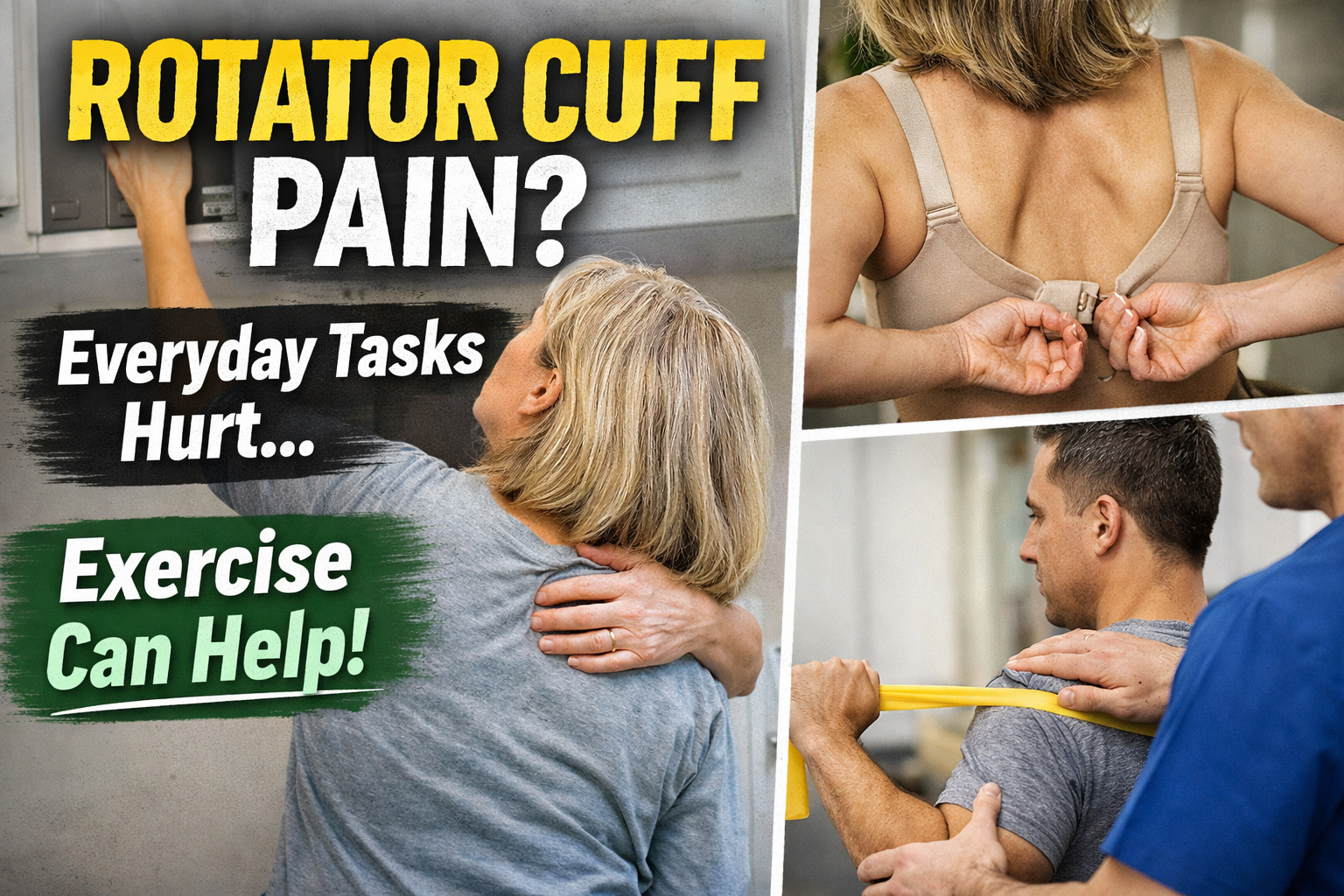
Shoulder pain has a way of disrupting ordinary life faster than people expect. Reaching into a cabinet, fastening a bra, lifting a bag, washing your hair, or trying to sleep on one side can suddenly feel awkward, weak, or sharply uncomfortable. That is part of what makes rotator cuff problems so frustrating. They often start as something that seems minor, but the shoulder can become irritated enough that everyday movement changes. The good news is that exercise is often part of the solution. Mayo Clinic notes that physical therapy is commonly one of the first treatments for rotator cuff injuries, and that targeted exercises can help restore shoulder flexibility and strength. MedlinePlus similarly emphasizes that exercises can help strengthen the muscles and tendons around the shoulder and improve movement.
What the rotator cuff actually does
The rotator cuff is not one single muscle. It is a group of four muscles and their tendons that form a cuff around the shoulder joint: the supraspinatus, infraspinatus, teres minor, and subscapularis. Together, they help keep the head of the upper arm bone centered in the shoulder socket while you lift, rotate, and control the arm. In simple terms, the rotator cuff helps the shoulder stay stable while still allowing it to move freely.
That balance between mobility and stability is exactly why rotator cuff issues can feel so limiting. When the tendons become irritated, inflamed, or torn, the shoulder may hurt at night, feel weak with lifting or rotation, and lose some range of motion. Mayo Clinic and AAOS both note that rotator cuff injuries can range from irritation and inflammation to partial or full tendon tears, and that symptoms often include aching pain, weakness, and difficulty with overhead or behind-the-back movement.
When rotator cuff exercises help
Rotator cuff exercises are often useful in three broad situations: when the shoulder is mildly irritated from overuse, when a clinician or physical therapist has recommended rehabilitation for a non-emergency rotator cuff problem, and when you want to maintain shoulder strength and control to reduce future problems. For many people with rotator cuff pain, exercises are enough to improve symptoms and function.
But home exercise is not the right starting point for every shoulder problem. Mayo Clinic advises prompt medical evaluation if you develop immediate arm weakness after an injury. AAOS notes that tears that happen suddenly, such as after a fall, can cause intense pain and immediate weakness. In practical terms, if you injure your shoulder and suddenly cannot actively lift the arm the way you could before, do not treat that as a routine “stretch it out” situation.
Red flags: when to stop self-managing and get checked
A shoulder that needs evaluation is not always dramatic, but certain patterns deserve attention sooner rather than later. Get medical advice promptly if your pain followed trauma, if you have clear new weakness, if the pain keeps waking you at night, or if daily tasks like reaching overhead or rotating the arm become steadily harder instead of better. Seek urgent help after an acute injury if you have immediate weakness or major loss of active movement.
It is also smart to stop and reassess if exercises consistently make pain worse rather than calmer. MedlinePlus advises that if you have pain during or after an exercise, you may need to change the way you are doing it or lower the resistance. That is an important rule for the rotator cuff because these are relatively small stabilizing muscles, not muscles that respond well to aggressive loading too early.
The safest principles before you start
The best rotator cuff program usually looks less dramatic than people expect. It is not about lifting heavy weights overhead right away. It is about calm, controlled movement, shoulder-blade control, and gradually rebuilding tolerance. MedlinePlus specifically notes that rotator cuff strengthening should focus on lower weights and higher repetitions.
A few rules matter more than almost any individual exercise:
Warm up with gentle motion before strengthening.
Use light resistance at first.
Keep movements slow and controlled.
Stop short of sharp pain.
Prioritize technique over weight.
Mild aching, light stretching discomfort, or muscle fatigue can be normal during rehab. Intense pain is not. A University Hospital Southampton patient guide notes that mild discomfort or stretching sensations may occur, but intense or long-lasting pain should not.
The most useful rotator cuff exercises
The exercises below are the ones most consistently supported in patient-facing orthopedic and rehabilitation guidance. They are not the only options, but they form a practical, safer foundation.
1. Pendulum swings
This is often one of the earliest exercises used when the shoulder is irritated because it encourages gentle joint motion without asking the shoulder to do much active work. AAOS includes pendulum swings in its shoulder conditioning program.
How to do it:
Stand beside a table or counter and support yourself with the unaffected arm. Let the painful arm hang relaxed. Gently swing it forward and back, side to side, and then in small circles. The motion should feel easy and loose, not forced. Start with about 1 to 2 minutes.
Best for: early pain, stiffness, warming up before other exercises.
2. Assisted shoulder motion with a stick or cane
When active movement is painful, assisted motion can help maintain range without forcing the injured side to do all the work. MedlinePlus notes that passive exercises can help get full movement back, and AAOS includes passive rotation stretches in its program.
How to do it:
Lie on your back or stand comfortably with a stick, cane, or broom handle in both hands. Use the stronger arm to help guide the affected arm through a comfortable range. A good starting point is assisted external rotation with the elbow tucked by the side, or assisted forward elevation if that has been recommended for you. Move only to a gentle pull, not pain.
Best for: early recovery, stiffness, people who cannot yet move comfortably through full range on their own.
3. Scapular setting or shoulder-blade squeezes
The shoulder does not work well when the shoulder blade moves poorly. MedlinePlus emphasizes the role of the muscles around the shoulder blade and proper shoulder posture, and UHS guidance specifically includes scapular setting with neutral posture and avoiding slumping.
How to do it:
Sit or stand tall. Gently draw the shoulder blade back and slightly down, as if tucking it into a back pocket. Do not shrug. Do not arch your lower back. Hold for a few seconds, then relax.
Best for: posture-related shoulder pain, improving control before strengthening.
4. External rotation with a resistance band
This is one of the most useful strengthening exercises for the rotator cuff, especially the infraspinatus and teres minor. AAOS includes band external rotation with the elbow at the side in its conditioning program.
How to do it:
Anchor a light resistance band at elbow height. Stand with the elbow bent to 90 degrees and tucked against your side. Rotate the forearm outward slowly, keeping the elbow close to the body. Return with control. Start with a light band and pain-free repetitions.
Common mistakes: letting the elbow drift away from the ribs, twisting the body, moving too fast, or starting with too much band tension. These errors shift the work away from the cuff and make the exercise less useful.
5. Internal rotation with a resistance band
Internal rotation targets muscles on the front side of the cuff and surrounding shoulder stabilizers. AAOS includes this movement as a standard part of shoulder conditioning.
How to do it:
With the elbow bent and tucked to your side, pull the band inward across the body. Return slowly. Keep the motion small and controlled rather than forceful.
Best for: balanced shoulder strengthening when tolerated alongside external rotation.
6. Wall isometrics
Isometric work lets you activate the shoulder without visible joint motion, which can be helpful when movement is still sensitive. Mayo Clinic includes wall-based rotator cuff pressing exercises, and UHS guidance describes gentle wall isometrics at low effort.
How to do it:
Bend the elbow to 90 degrees and place a folded towel between the upper arm and your side. For internal rotation, press the palm into a wall or door frame. For external rotation, turn so the back of the hand or forearm presses outward into the wall. Hold gently for several seconds. Think light to moderate effort, not maximum force.
Best for: the bridge between painful early rehab and fuller strengthening.
7. Side-lying external rotation
This is a more focused strengthening exercise once basic pain control and motion are better. AAOS includes a side-lying external rotation exercise using very light weight.
How to do it:
Lie on the non-painful side with the affected arm on top, elbow bent at 90 degrees and resting against the body. Hold a very light weight, often 1 to 2 pounds to start, and rotate the forearm upward. Lower slowly.
Best for: later-stage strengthening when band work is well tolerated.
8. Side-lying internal rotation
This is another later-stage move for controlled strengthening of internal rotation. AAOS includes it with similarly light loads.
How to do it:
Lie on the affected side with the elbow bent to 90 degrees and tucked in. Lift the forearm upward through a comfortable range, then lower slowly. Keep the body still.
Best for: balanced shoulder strength after pain has calmed.
A simple progression that makes sense
A lot of people worsen shoulder pain because they choose the right exercises in the wrong order. A safer sequence is usually this:
Phase 1: calm the shoulder and restore motion
Start with pendulum swings, assisted range-of-motion work, and scapular setting. This phase is about reducing guarding, preserving mobility, and improving shoulder-blade control.
Phase 2: add low-load activation
Once those feel easier, introduce wall isometrics and then light band work for internal and external rotation. The goal here is to wake the cuff up without overloading it.
Phase 3: build strength gradually
When you can move with better control and less irritation, add side-lying external and internal rotation with very light dumbbells. MedlinePlus and AAOS both support the idea of lower weight, higher repetition work for the cuff.
This progression also fits how many rehab programs are structured: passive or assisted motion first, strengthening after that, and then more challenging work later as symptoms allow.
How often should you do them?
Not every shoulder exercise needs to be done on the same schedule. AAOS lists pendulum work and stretches more frequently, often 5 to 6 days per week, while many strengthening drills are programmed around 3 days per week. That pattern makes sense in practice: gentle mobility can often be done more often, while strengthening usually benefits from recovery time between sessions.
A practical starting pattern is gentle motion most days, with strengthening every other day. If the shoulder becomes more sore at night, more irritable the next morning, or progressively weaker, that is a sign to reduce intensity and reassess technique. MedlinePlus specifically advises changing technique or lowering resistance if pain occurs during or after exercise.
The mistakes that slow recovery
One of the biggest mistakes is using too much resistance too soon. Rotator cuff muscles are small stabilizers, and both MedlinePlus and AAOS rehab guidance emphasize lighter loading rather than chasing heavy weight.
Another common problem is poor posture. If you exercise while slumped, shrugging, or letting the shoulder blade wing or tip forward, the movement often becomes less clean and more irritating. MedlinePlus highlights correct posture, and UHS specifically advises neutral spinal posture and avoiding slumping during scapular work.
People also get into trouble by treating pain as proof the exercise is “working.” That approach backfires with an irritated shoulder. Mild discomfort can happen, but sharp pain, worsening night pain, or pain that lingers after the session means the program needs to be adjusted.
What improvement should feel like
Progress does not always show up as dramatic strength gains first. Often the earliest signs are smaller but meaningful: it hurts less to reach into a cabinet, sleep becomes easier, the shoulder feels less guarded, or you can lift the arm with better control. Over time, you want more comfortable range of motion, less weakness, and better tolerance for ordinary tasks. Mayo Clinic notes that exercises are meant to restore flexibility and strength, and AAOS notes that specific exercises can restore movement and strengthen the shoulder.
If the opposite is happening, meaning pain is escalating, weakness is more obvious, or function is dropping, the answer is not usually “push harder.” It is to pause, simplify, and get the shoulder assessed if needed. Without appropriate treatment, Mayo Clinic notes that rotator cuff problems can lead to ongoing weakness or loss of motion.