DVT Symptoms: Early Warning Signs of Deep Vein Thrombosis You Should Not Ignore
DVT Symptoms: Early Warning Signs of Deep Vein Thrombosis You Should Not Ignore
A sore calf is easy to dismiss. Many people blame leg discomfort on exercise, standing too long, dehydration, travel, or getting older. Sometimes that is exactly what it is. But sometimes the problem is not a simple muscle issue at all. It is a blood clot in a deep vein, a condition called deep vein thrombosis, or DVT. DVT most often develops in the lower leg, thigh, or pelvis, though it can also happen in an arm.
What makes DVT so important is not just the clot itself. The real danger is that part of the clot can break loose and travel to the lungs, causing a pulmonary embolism, or PE. That complication can become life-threatening quickly. Mayo Clinic, NHLBI, MedlinePlus, and CDC all describe DVT and PE as parts of the same venous thromboembolism picture, with symptoms that deserve prompt medical attention.
DVT does not always announce itself dramatically. Some people have obvious swelling and pain. Others notice only subtle changes, such as one leg looking a little larger, feeling warmer, or cramping in a way that does not behave like an ordinary muscle spasm. And some people have no noticeable symptoms at all.
That is why the most useful question is not, “Does my leg hurt?” It is, “Does this pain fit the pattern of a possible clot?” Here are the DVT symptoms that matter most.
What is DVT?
Deep vein thrombosis happens when a blood clot forms in a vein deep inside the body, usually in a leg. The clot can partly or completely block blood flow. That blockage can cause swelling, pain, warmth, and color changes in the limb. If the clot travels to the lungs, it becomes a pulmonary embolism.
DVT is not rare. CDC says venous thromboembolism, the umbrella term that includes DVT and pulmonary embolism, affects as many as 900,000 Americans each year, and blood clots contribute to many deaths.
1. Swelling in one leg is one of the biggest warning signs
The most classic DVT symptom is swelling in the affected limb, especially when it shows up on one side rather than both. A calf, ankle, or entire leg may look puffier, feel tighter, or seem noticeably larger than the other side. Shoes, socks, or pant legs may suddenly feel more restrictive on that side.
This happens because the clot interferes with normal blood return through the vein. As blood flow backs up, fluid can collect in nearby tissues. The swelling may appear gradually or come on more suddenly, depending on the clot’s size and location.
Swelling matters even more when it appears together with pain, warmth, or skin color change. A swollen leg after a long day is not automatically DVT, but one-sided swelling with other warning signs should not be brushed off.
2. Calf pain, soreness, or tenderness that does not feel “normal”
DVT pain is often described as aching, cramping, soreness, or tenderness, and it commonly starts in the calf. Some people say it feels like a pulled muscle or a charley horse that does not improve the way a normal muscle cramp should.
The pain may be mild or quite uncomfortable. It may worsen when standing or walking, and the area may feel tender if touched. That can make DVT easy to confuse with overuse, a minor strain, or post-workout soreness.
A key clue is the pattern. Muscle soreness usually makes sense in context. It follows activity, gradually settles down, and often affects both sides or a clearly overworked area. DVT pain often feels more one-sided, more persistent, and more out of proportion to what a person can explain with ordinary strain.
3. Warmth over the painful or swollen area
A leg with DVT may feel warmer than the other leg, particularly over the area where the clot is affecting blood flow. Warmth is one of the common symptoms listed by Mayo Clinic, MedlinePlus, and Cleveland Clinic.
People do not always notice this symptom right away, because warmth can be subtle. But when a tender, swollen calf also feels unusually warm compared with the other side, that pattern is more concerning than soreness alone.
4. Red, purple, or otherwise discolored skin
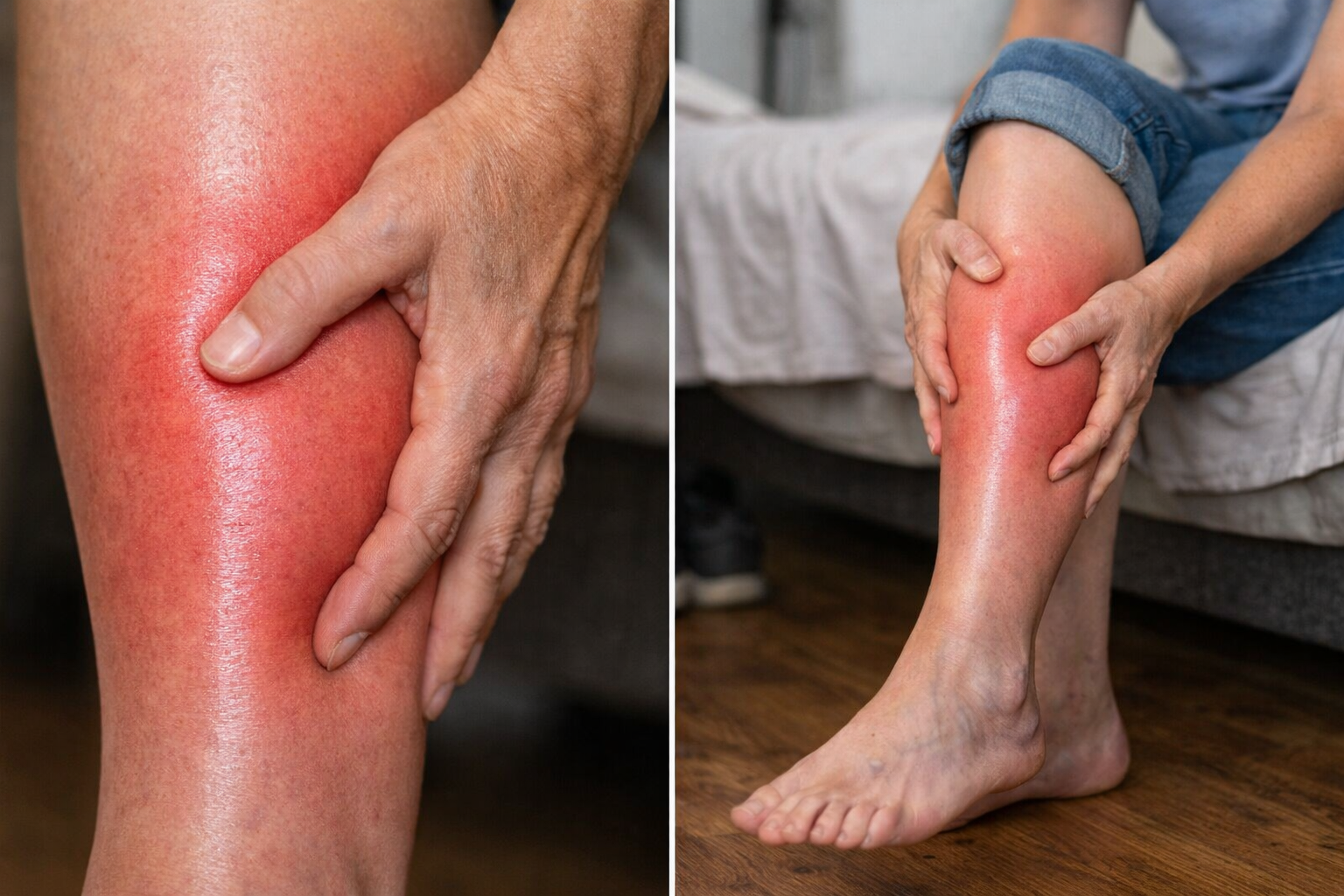
Skin color changes are another major clue. The skin over the affected area may look red, flushed, darker than usual, or purplish, depending on a person’s skin tone and the degree of blood flow disruption. Mayo Clinic specifically notes red or purple color change, and MedlinePlus and Cleveland Clinic also list redness or discoloration among common symptoms.
This symptom is easy to miss when the change is subtle, especially in darker skin tones. Sometimes the leg does not look vividly red, but simply different from the other side. Comparing both legs in good light can make that easier to notice.
5. Cramp-like pain that keeps returning or does not improve
Many people with DVT describe the discomfort as cramping rather than sharp pain. That is one reason clots are often underestimated at first. A person may try stretching, massage, hydration, or rest and assume the problem will pass.
What makes the cramp more suspicious is when it keeps coming back, does not improve as expected, or is paired with swelling, warmth, or discoloration. In other words, the cramp is not the whole story. It is the cramp plus the one-sided physical changes that raise concern.
6. Tight, shiny skin or more visible surface veins
As swelling builds, the skin may feel stretched or look shiny. In some cases, veins closer to the skin become more noticeable than usual. Cleveland Clinic notes that larger-than-normal veins near the skin’s surface can happen with DVT, while swelling itself can make the skin feel tight.
This is not the most famous DVT symptom, but it can be useful in real life. If one lower leg looks fuller, tighter, and more glossy than the other, especially with pain or warmth, that is not something to ignore.
Can you have DVT without obvious symptoms?
Yes. DVT can happen without noticeable symptoms. That is an important reason the condition can be missed. Mayo Clinic says DVT can occur without noticeable symptoms, and NHLBI notes that venous thromboembolism can sometimes occur without obvious signs.
This matters most in people with risk factors, such as recent surgery, hospitalization, prolonged immobility, active cancer, pregnancy or the postpartum period, estrogen-containing birth control or hormone therapy, prior DVT or PE, inherited clotting disorders, increasing age, obesity, or a central venous catheter.
CDC also notes that risk rises when more than one factor is present at the same time. A long trip alone may not cause a clot in most people, but long immobility combined with surgery, estrogen use, pregnancy, illness, or clotting tendency is more concerning.
When DVT becomes an emergency: signs of pulmonary embolism
The emergency is not only the leg clot. The emergency is what happens if that clot travels. A pulmonary embolism can cause sudden shortness of breath, chest pain that gets worse with a deep breath or cough, rapid breathing, rapid pulse, dizziness, fainting, or coughing up blood.
If DVT symptoms appear together with any of those lung-related symptoms, that is urgent emergency care territory. Do not wait to see whether it settles down on its own.
How doctors check for DVT
Doctors diagnose DVT based on symptoms, medical history, physical examination, and testing. NHLBI and MedlinePlus note that common tests include a D-dimer blood test and compression ultrasound, which is the main imaging test used to look for clots in the deep veins of the legs.
A D-dimer can be helpful as an early blood test in some people, but ultrasound is usually the key test for confirming or ruling out a clot in the leg. In certain cases, additional imaging may be used if the diagnosis is still unclear.
What to do if you think you may have DVT
If you have new one-sided leg swelling, persistent calf pain, warmth, or color change, contact a healthcare professional promptly for evaluation. Mayo Clinic specifically advises seeking medical attention for DVT symptoms, because early treatment can prevent the clot from getting larger or turning into a pulmonary embolism.
Do not assume that a blood clot can be ruled out just because the pain is tolerable. DVT can be subtle. And do not rely on self-diagnosis based on stretching, massage, or internet symptom comparison. If the pattern fits, it needs proper assessment.
Quick symptom checklist
Possible DVT becomes more concerning when you notice one or more of the following, especially on one side only: swelling, calf pain or tenderness, warmth, redness or discoloration, a cramp-like feeling that does not behave like a normal cramp, and skin that looks tight, shiny, or unusually vein-prominent.
Possible pulmonary embolism becomes an emergency when you add sudden shortness of breath, chest pain with breathing, fainting, lightheadedness, rapid breathing, rapid pulse, or coughing up blood.